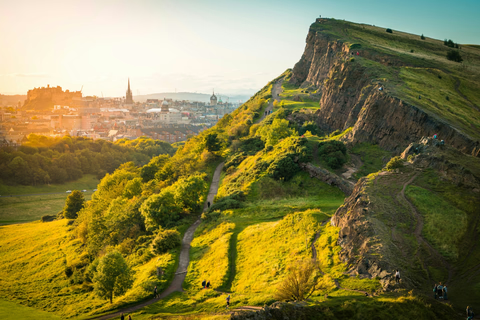
If you love nature, Holyrood Park offers some of the most typical Scottish landscapes just minutes from central Edinburgh. Climbing Arthur’s Seat, the extinct volcano dominating the city’s skyline, should definitely be on your to-do list!
A nature trip in the middle of Edinburgh
Few cities let you head into nature without leaving the centre. Right next to the Old Town you’ll find Holyrood Park, a huge natural space of more than 260 hectares, with hills, cliffs, lochs and glens so typical of the Scottish landscape.
The park was a royal hunting ground attached to the Palace of Holyroodhouse, and it is still a royal park today. Its rocks are the remains of a volcano that was active around 350 million years ago, later shaped by glaciers during the Ice Age.
You’ll see both visitors and locals here, making the most of every day the weather allows. And you can enjoy it whatever your fitness level, as there are paths and routes for everyone.
Climbing to the top of Arthur’s Seat is very rewarding: a small physical challenge with spectacular views over all of Edinburgh and its surroundings as the prize.

Practical information
Opening hours
- Every day, all year
- 24 hours
At weekends, the park roads are closed to vehicles during the day (roughly from 8.15–9am to 3.45pm), which makes it very pleasant for walking and cycling.
Entry
Free.
Facilities
Public toilets at the Holyrood Park Education Centre. Car parks at Broad Pavement (£1 per hour on weekdays), St Margaret’s Loch and Duddingston Loch. There are no cafés or water fountains on the hill.
How to climb Arthur’s Seat
Arthur’s Seat is the highest point in the park, at 251 metres. It isn’t a high mountain, but it is a real hill, with some 230 metres of ascent from the bottom of the Royal Mile. Allow about two hours for the round trip, including time to enjoy the views. These are the main options:
The classic route from the Palace
The most popular route starts on Queen’s Drive, next to the Palace of Holyroodhouse. It climbs past the ruins of St Anthony’s Chapel and then becomes steeper and rockier towards the summit. It is about 4 km there and back. The last stretch crosses polished rock that can be slippery, so take care, especially when it’s wet.
The shortest route from Dunsapie Loch
If you want the easiest climb, start from Dunsapie Loch, on the east side of the park. As you start much higher up, it only takes about 20 minutes to reach the summit along a grassy path. Bear in mind that the Dunsapie car park is only open to vehicles a few days a week, so it’s usually best to walk or cycle there along Queen’s Drive.
The Salisbury Crags loop
If you don’t have the time or energy to reach the summit, another option is Salisbury Crags, the dramatic cliffs you’ll see at the start of the park. A loop of about 3.5 km along the top of the cliffs takes an hour to an hour and a half and offers superb views of the Old Town and the Castle. Keep well back from the edge.

Exceptional views of the city and beyond
The 360° panorama from the summit is one of the best views of Edinburgh, reaching over the Old Town, the New Town and the Castle, and as far as East Lothian, the North Sea and Fife, across the Firth of Forth.
Salisbury Crags is one of the best places to watch fireworks over the city, especially on Bonfire Night (5 November), and a great spot for a photo of the Old Town.
Sunrise or sunset from Arthur’s Seat
Early morning is one of the most popular times to climb, especially in summer, when it’s less cold at that hour, and especially in August, after a night of Fringe shows and parties!
Get up early enough and you’ll be rewarded with the sunrise from the top of the hill. And afterwards, what better plan than a hearty Scottish breakfast?
The sunset over the Old Town from Arthur’s Seat is another highlight. Just don’t linger too long: head down before dark, as the descent can be dangerous. Remember you’re on a real hill and need to take precautions.

What else to see in Holyrood Park
St Margaret’s Loch and St Anthony’s Chapel
Near the Palace entrance is St Margaret’s Loch, a small artificial loch from the 19th century, popular with swans and ducks. Above it stand the ruins of St Anthony’s Chapel, a 15th-century chapel whose remaining walls frame one of the most photographed views in the park.
Salisbury Crags and Hutton’s Section
Salisbury Crags are not only a viewpoint: they are a key site in the history of science. At Hutton’s Section, at the southern end of the cliffs, the geologist James Hutton, considered the father of modern geology, found evidence in the 18th century that the Earth was far older than people believed. 2026 marks 300 years since his birth.
The Radical Road
The path running along the foot of Salisbury Crags, the Radical Road, was built in 1820 by unemployed weavers, at the suggestion of Sir Walter Scott. It has been closed since 2018 because of the risk of rockfalls. Historic Environment Scotland is working to reopen parts of it, so check its current status before you go.
Dunsapie Loch
On the east side of the park, below Arthur’s Seat, lies Dunsapie Loch, created in the 19th century. It’s a peaceful spot with views east over East Lothian, and the starting point of the easiest route to the summit.
Duddingston Loch and village
For a more relaxed walk, follow one of the flatter paths around the park to Duddingston Loch, an important bird sanctuary on the south side of the park. You may also spot Samson’s Ribs on the way, an impressive wall of basalt columns formed by the old volcano.
Next to the loch, in Duddingston village, is The Sheep Heid Inn, which claims to be one of the oldest pubs in Scotland, dating back to the 14th century. Book ahead, especially if you want to eat there.

Tips for visiting Holyrood Park
- Wear proper footwear: the paths are uneven, and rock and grass get slippery in the rain.
- Bring water and a warm layer: there are no facilities on the hill and it is often very windy at the top, even in summer.
- Avoid the summit in fog, strong wind or ice, and stay on the marked paths, away from cliff edges.
- Plan to come down before dark if you go up for the sunset, and bring a torch just in case.
- Respect the wildlife: fulmars nest on Salisbury Crags, and Duddingston Loch is a nature reserve.
Legends and mysteries
Arthur’s Seat has plenty of fascinating stories. The most popular says its name comes from the legendary King Arthur, and that this was once Camelot. A Celtic legend claims the hill is a dragon that curled up and fell asleep, never to wake again, which sort of makes sense, as it was once a fire-breathing volcano!
There are true stories too: in 1836, seventeen miniature coffins containing wooden figures were found buried on the hillside. Nobody knows why they were put there, but one popular theory links them to Burke and Hare, who murdered people to sell their bodies to the medical school. You can see some of them at the National Museum of Scotland.
So if you want a walk in nature without leaving Edinburgh, put on your boots and explore Holyrood Park: climb its hills or simply stroll along its easier paths.

Frequently asked questions
About 45 minutes to the summit on the classic route from the Palace, and around two hours for the round trip with time to enjoy the views. From Dunsapie Loch the climb takes only about 20 minutes.
It’s a moderate walk suitable for most people with reasonable fitness, but the last stretch is steep and rocky. Wear proper footwear and take care in wet or windy weather.
No. Holyrood Park is free and open 24 hours a day, all year round.
The shortest and easiest route starts at Dunsapie Loch, on the east side of the park, as you start much higher up.
Yes, both are very popular. Check the sunrise and sunset times, bring a torch and warm clothes, and avoid coming down the rocky sections in the dark.
Location
You reach Holyrood Park by walking to the bottom of the Royal Mile, past the Palace of Holyroodhouse and the Scottish Parliament. Queen’s Drive circles the park, and you can join many of the paths from other points along it, such as Dunsapie Loch or Duddingston.
Get directions to Holyrood Park.